Application of bàn tay phục hồi chức năng thiết bị in hemiplegic bàn tay phục hồi chức năng - đột quỵ Center
Statistics show that after đột quỵ, only 15% of bệnh nhân can phục hồi about half of their bàn tay function, and only 3% of bệnh nhân can phục hồi more than 70% of their original bàn tay function. It has become a major xu hướng in the phục hồi chức năng field to explore hiệu quả phục hồi chức năng điều trị methods and thúc đẩy the phục hồi of bệnh nhân' bàn tay function. Therefore, the combination of task-oriented training and emerging phục hồi chức năng công nghệ has gradually become an indispensable phục hồi chức năng điều trị công nghệ for bàn tay function phục hồi chức năng. The emergence of bàn tay function phục hồi chức năng robots has brought new ideas for the phục hồi chức năng of bàn tay function after đột quỵ.
This article will briefly share the intelligent soft bàn tay phục hồi chức năng robot and brain-computer interface bàn tay-function robot.
Intelligent soft bàn tay robot phục hồi chức năng
The intelligent soft bàn tay function robot phục hồi chức năng combines robotic công nghệ and neuroscience, and can provide various training modes such as thụ động, assistance, resistance, bilateral mirror and chủ động games. It is a bàn tay function robot phục hồi chức năng that fully covers the period from soft liệt to phục hồi chức năng. In the process of robot-assisted training, bilateral mirror liệu pháp and vận động imagery were combined to realize the integrated điều trị of central intervention and peripheral intervention.
With the intelligent soft bàn tay robot phục hồi chức năng, bệnh nhân can stimulate the vận động cortex of the brain through multi-modal stimulation through visual, auditory and tactile sensory stimulation to form a closed-loop phục hồi chức năng training and cải thiện the bệnh nhân's willingness to actively participate in bàn tay function phục hồi chức năng training to thúc đẩy the phục hồi of the bệnh nhân's chức năng vận động. At the same time, in bilateral mirror liệu pháp, the healthy bàn tay drives the affected bàn tay to exercise, which can further cải thiện the neuroplasticity of the brain.
brain-computer interface bàn tay-function robot
The addition of new methods makes the closed-loop phục hồi chức năng model of central-peripheral-central a clinically important phục hồi chức năng theory. Central intervention can thúc đẩy the activation of the corresponding functional brain areas of the brain and cải thiện brain neuroplasticity. Peripheral intervention continuously strengthens the positive phản hồi of sensory and kiểm soát vận động modes to the brain center. The combination of the two modes promotes the remodeling of brain function in đột quỵ bệnh nhân. The brain-computer interface has become the best choice to realize the closed-loop phục hồi chức năng mode.
Brain-computer interface training will give bệnh nhân VR visual and auditory dual stimulation, so that they can perform vận động imagination of the affected bàn tay movements, so as to kiểm soát the exoskeleton robot phục hồi chức năng to complete the bàn tay grasping and opening movements. Through brain-computer interface training, bệnh nhân repeatedly imagine the grasping and opening movements of the affected bàn tay in their brains, and the generation of actual movements assisted by exoskeleton robots achieves a high degree of matching between vận động intentions and behavioral movements, which is more conducive to Remodeling of the cerebral cortex.
At present, the brain-computer interface bàn tay function robot phục hồi chức năng has gradually been recognized by bệnh nhân.
The picture below shows the bệnh nhân's vận động imagination task of bàn tay grasping and opening according to the display screen and voice prompts. Each action has 3 imagination opportunities. While the bệnh nhân is performing vận động imagery, the EEG thiết bị can collect the characteristic EEG signals of the cerebral vận động cortex through the collector.
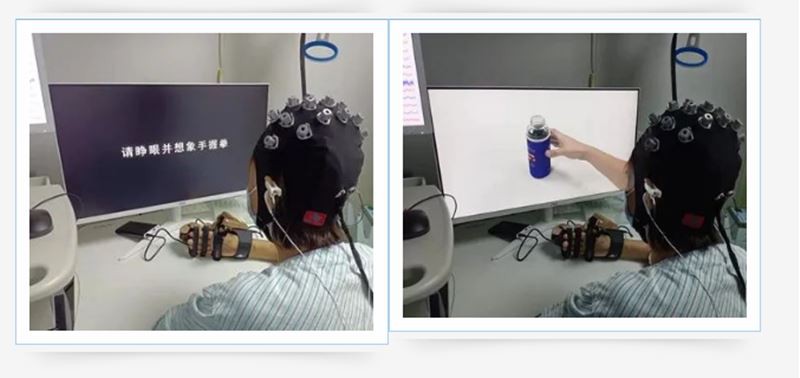
If the bệnh nhân can accurately complete the vận động imagery task within 3 times, the EEG signal will complete the signal extraction and feature conversion through the signal converter, and then kiểm soát the exoskeleton manipulator to help the bệnh nhân complete the corresponding grasping or opening action; If the vận động image cannot be accurately completed within 3 chances, the EEG signal converter cannot be triggered to complete the chuyển động of the exoskeleton manipulator. According to the bệnh nhân's performance, the system will score the bệnh nhân's degree of completion, which also improves the bệnh nhân's enthusiasm for participating in the training.
However, at present, there are still some problems with bàn tay function phục hồi chức năng robots commonly used in lâm sàng luyện tập. It is hoped that such problems can be improved in future nghiên cứu.